
Searching for the best IPTV 2026 experience in the UK isn’t just about “how many channels”. In 2026, the best results usually come from stability at peak time, clean EPG behaviour, sensible device setup, and clear service terms — so you can actually watch without daily frustration.
Best IPTV 2026 (UK): What to Look for Before Choosing a Service
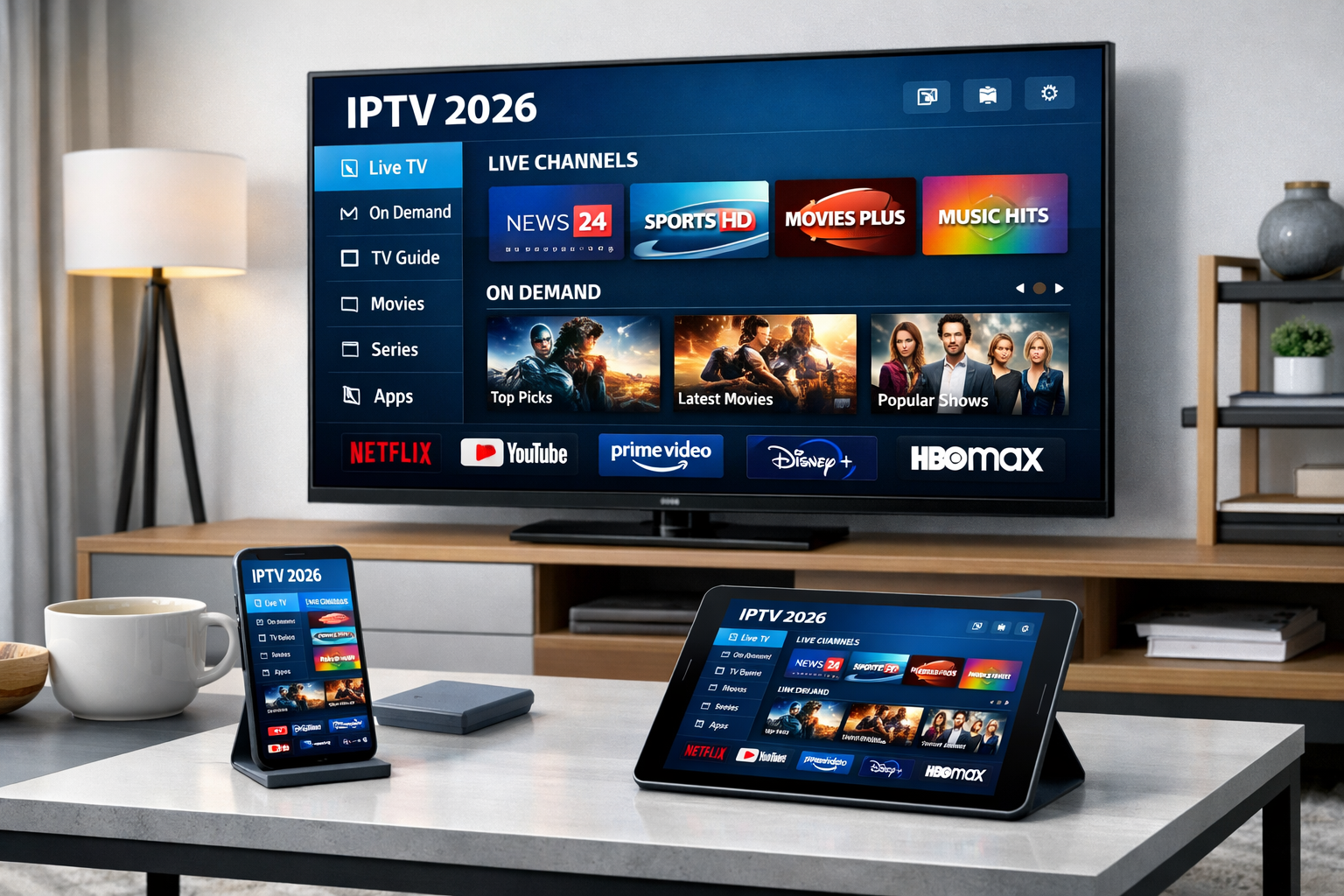
- Image prompt: Photorealistic UK living room. A modern smart TV shows a generic “Best IPTV 2026” evaluation dashboard (no logos) with neutral tiles: Peak-Time Test, EPG Accuracy, VOD Library, Multi-Device, Buffering Check, Support Response, Router/Ethernet. A streaming box and one remote on the console, plus a smartphone showing a matching checklist screen. No channel names, no copyrighted content, no brand marks. Soft daylight, realistic reflections, professional product-photo look, 16:9, high detail.
- SEO filename: best-iptv-2026-uk-guide.webp
- Exact alt text: best iptv 2026 services displayed on smart tv and mobile devices (UK)
Table of contents
- Why choosing carefully matters more in 2026
- What “best” should mean (practical definition)
- The 7 pillars of a strong 2026 IPTV experience
- The UK “48-hour test” that reveals the truth
- Device & network setup that stops most headaches
- EPG and guide reliability: what to check
- VOD libraries: quality signals beyond “big numbers”
- Support & operations: the hidden differentiator
- Transparency, terms, and risk reduction
- Red flags that usually predict disappointment
- FAQ
- External resources & internal guides
1) Why IPTV choices matter more in 2026
In 2026, internet TV is mainstream. UK households have faster broadband on average, better Wi-Fi standards, and more capable streaming devices. That sounds like it should make everything easy — but it also raises expectations. People want the experience to feel like “normal TV”: quick channel switching, predictable guide listings, stable playback at night, and a UI the whole household can use.
The market is also noisier. Many providers use the same marketing language, and the difference is often operational: how they handle peak time, how they maintain their servers, and whether they manage libraries and guide feeds in a consistent way. That’s why a “best” choice in 2026 is usually the one that stays boring (in a good way) during real viewing hours.
2) What “best” should mean (a practical definition)
Instead of chasing brand names, define “best” as a combination of outcomes you can verify:
- Peak-time stability: minimal buffering/freezing during evening viewing.
- Predictable navigation: quick access to favourites, categories, and search.
- Guide reliability: EPG behaves consistently (when guide data exists).
- Device fit: the service works well on your actual devices, not just in ads.
- Operational clarity: reasonable terms, support responsiveness, and a clear way to troubleshoot.
With that definition, you can evaluate any service without getting trapped by hype. You also reduce “buyer’s remorse” because you’re measuring the experience you’ll actually live with: nights, weekends, sports events, family use, and device switching.
3) The 7 pillars of a strong 2026 IPTV experience
1) Stability under load
The biggest difference between a smooth service and a frustrating one is how it behaves when many people are watching: evenings, weekends, and major live events. If it collapses at the exact time you want to watch, nothing else matters.
- Test at peak time, not only midday.
- Test more than one channel/category.
- Check how fast you recover after a short dropout.
2) Stream switching speed
Even with decent quality, a service can feel “cheap” if switching channels takes too long. Fast switching usually comes from good routing + stable infrastructure, but your device also matters.
- Try 10 quick switches in a row.
- Try the same test on a second device.
- Check if the player UI freezes during switching.
3) EPG accuracy and consistency
The guide is a daily-use feature. When it works, households browse by time and programme. When it doesn’t, people end up guessing and the experience feels messy.
- Confirm your device time/timezone is correct.
- Check if EPG is complete across multiple categories.
- Look for “No information” patterns.
4) Library organisation (not just size)
A huge list can be a negative if it’s duplicated, messy, or slow to browse. A well-organised library with clean categories and sensible naming often feels better than raw volume.
- Look for duplicates and confusing category spam.
- See if favourites and search work reliably.
- Check poster/metadata load speed (VOD/Series).
5) Multi-device compatibility
In real UK households, people watch across a main TV device plus at least one mobile device. The best experience is consistent: same behaviour, same reliability, easy profile switching.
- Test on your main TV device first (stick/box).
- Confirm mobile/tablet playback for quick checks.
- Watch for account/device limit clarity.
6) Support and operational maturity
When something breaks (EPG, portal access, loading issues), the speed and clarity of support becomes the difference between “minor annoyance” and “dead service”.
- How quickly do they respond?
- Do they give clear troubleshooting steps?
- Do they acknowledge outages transparently?
7) Transparency and safe expectations
Strong services set realistic expectations: internet conditions matter, device matters, peak time matters. If everything is framed as “perfect always”, that’s usually a warning sign.
- Look for clear terms, policies, and scope.
- Avoid aggressive hype that dodges specifics.
- Prefer services that encourage testing.
4) The UK “48-hour test” that reveals the truth
If you only do one thing before choosing, do a short structured test. It keeps you out of marketing land and inside real usage. The goal is to answer: “Will this feel stable for my household at the times we actually watch?”
Step A: Baseline your network (10 minutes)
- Use Ethernet for the main TV device if possible (even temporarily for testing).
- If Wi-Fi is required, use 5GHz near the router for the test.
- Pause big downloads/updates while testing to avoid false results.
Step B: Peak-time playback test (30–45 minutes)
- Test between 7–11 PM UK time.
- Watch at least 3 different live channels/categories.
- Do 10 rapid channel switches and note delays/freezing.
- Check whether buffering clusters around certain times.
Step C: The “UI reality” test (10 minutes)
- Create a favourites list (10–20 items) and see if the app stays responsive.
- Try search and category navigation under normal use.
- Check if the player becomes slow after browsing for a while.
Step D: EPG check (5–10 minutes)
- Confirm device time/timezone is correct.
- Refresh EPG, wait a minute, then open the guide.
- Check if guide data is consistent across categories (not just one group).
Step E: Second device confirmation (5–10 minutes)
- Play the same stream on a second device (mobile or tablet).
- If possible, try a brief hotspot test to isolate home Wi-Fi/ISP issues.
The purpose isn’t to chase perfection. It’s to avoid the common trap where a service looks fine at lunchtime and collapses at night.
5) Device & network setup that prevents most problems
Many “service problems” are actually setup problems. Before you blame a provider, make sure your viewing pipeline is stable: router → Wi-Fi/Ethernet → streaming device → IPTV player → stream.
Best stability move
Ethernet for the main TV device (even one test) often changes everything. If Ethernet is impossible, treat Wi-Fi like a design problem: distance, walls, interference.
- Prefer 5GHz close to router
- Avoid placing device behind the TV if it overheats
- Restart router occasionally (especially after firmware updates)
Best performance move
Use a capable streaming device and keep storage free. Low storage and low memory can cause UI lag, crashes, and stutter.
- Keep at least a few GB free storage
- Close heavy background apps
- Restart low-memory devices weekly
If buffering only happens on Wi-Fi and disappears on Ethernet, that’s useful information. It means you can improve results without changing anything else — just by strengthening the network path.
6) EPG and guide reliability: what to check
EPG quality is a “quiet feature” that massively affects daily usability. Even strong streams feel annoying if the guide is blank, shifted by hours, or randomly disappears.
Fast checks
- Timezone/time: confirm your device clock is correct (wrong time breaks guide alignment).
- Refresh: refresh EPG and wait 60–120 seconds.
- Cache: clear cache if EPG loads once then vanishes.
- Coverage: test multiple categories, not just one.
| Symptom | Likely cause | Best first step |
|---|---|---|
| EPG blank everywhere | Guide feed down / not provided | Refresh, wait, confirm EPG exists |
| EPG shows wrong hours | Timezone/time mismatch | Fix device time, restart app |
| Only some categories show EPG | Incomplete mapping | Test other groups, rebuild favourites |
| EPG loads then disappears | Cache/memory issues | Clear cache + restart device |
7) VOD libraries: quality signals beyond “big numbers”
Many services advertise huge VOD counts. In practice, the more useful questions are: “Is it organised?”, “Does it load quickly?”, “Do posters/metadata behave consistently?”, and “Does playback start reliably?”
What to look for
- Organisation: clean categories and search that actually finds titles.
- Metadata quality: posters and descriptions load quickly and correctly.
- Playback consistency: starting a title works without repeated retries.
- Performance on your device: big libraries can slow weaker devices.
A smaller library that loads smoothly and is easy to browse often feels better than a massive one that stutters and takes ages to open. For “best experience” decisions, usability beats numbers.
8) Support & operations: the hidden differentiator
Most people only value support after something breaks. In reality, support quality is a direct signal of operational maturity. Strong operations look like: quick responses, clear steps, honest acknowledgement of outages, and practical advice about devices/networking.
Simple support test
- Ask one clear question during your test window (for example: “How do I refresh EPG?” or “Which input method is recommended for TV devices?”).
- Measure response time and clarity (not just friendliness).
- Watch whether they give troubleshooting steps or only sales pressure.
If support ignores technical questions and only pushes “buy longer”, that’s rarely a good sign for long-term reliability.
9) Transparency, terms, and risk reduction
In 2026, risk reduction is part of smart choosing. The best outcomes usually come from providers that are clear about what they offer, what devices they support, and what their policies are. You want fewer surprises.
Good transparency signals
- Clear terms and policies (refund, support hours, usage limits).
- Realistic claims about stability and peak-time behaviour.
- Encouragement to test before committing long-term.
- Clear explanation of setup methods and requirements.
10) Red flags that usually predict disappointment
Red flag: “Perfect, no buffering ever”
No streaming system can guarantee perfection across every ISP, router, and device. Over-promising usually means under-delivering at peak time.
Red flag: no testing path
If there’s no reasonable way to test the real experience (especially at night), you’re being asked to commit without evidence.
Red flag: unclear terms
If policies are vague or missing, you’re exposed to misunderstandings later. Clear terms are a trust signal.
Red flag: messy libraries and UI overload
Huge duplicated categories and slow browsing usually lead to daily frustration. Clean organisation is a stronger “quality” signal than raw volume.
Red flag: support only does sales
When support can’t answer basic setup questions, it usually means issues will take longer to resolve when something breaks.
Red flag: you must install risky extras
Avoid “miracle optimizer” apps and unknown add-ons. A strong experience should come from a stable device + stable network + clear setup.
Red flags don’t always mean “bad”, but they should push you to test harder, ask clearer questions, and avoid long commitments until you’re sure.
FAQ
Is “best” mostly about channel count?
In 2026, channel count alone is a weak signal. The daily experience is driven by peak-time stability, switching speed, device performance, and guide reliability. Focus on outcomes you can test.
What’s the fastest way to judge reliability?
Do a peak-time test (7–11 PM UK time), then repeat on a second evening. If it holds steady during real viewing hours, it’s usually a strong sign.
Why does buffering happen even with fast internet?
Speed isn’t the whole story. Wi-Fi interference, router congestion, device decoding limits, and upstream load during peak time can all cause buffering. One Ethernet test helps isolate the cause quickly.
How important is the IPTV player app?
The player affects navigation, favourites, and guide usability. But it can’t override upstream instability. A good player + clean favourites list makes the experience feel faster and simpler. Start with: IPTV Player Explained.
What should I check before a longer plan?
Confirm peak-time stability, device compatibility, guide behaviour, and support responsiveness. Short structured testing reduces risk more than any marketing promise.
🌐 External resources
Neutral, non-provider references (safe outbound linking).
- Internet Protocol television (Wikipedia)
- UK NCSC: Top tips for staying secure online
- How streaming works (Cloudflare)
- Clear cache (Google Support)
- Media delivery basics (Akamai)
Related internal posts
- IPTV Subscription Guide
- IPTV Player Explained
- IPTV Stream Explained
- IPTV Smarters Player Guide
- IPTV Providers Checklist
- Pricing (plans overview)
Internal linking builds topical authority while keeping external references neutral and low-risk.