
An IPTV player is a playback app that loads playlists or login details from a service you already use.
It does not provide channels by itself. This UK guide explains how IPTV player apps work, what features matter,
how to choose the right type for your devices, and how to fix the most common issues (EPG, buffering, playlist loading).
IPTV Player Explained (UK): What It Is, How It Works, and How to Choose One Safely
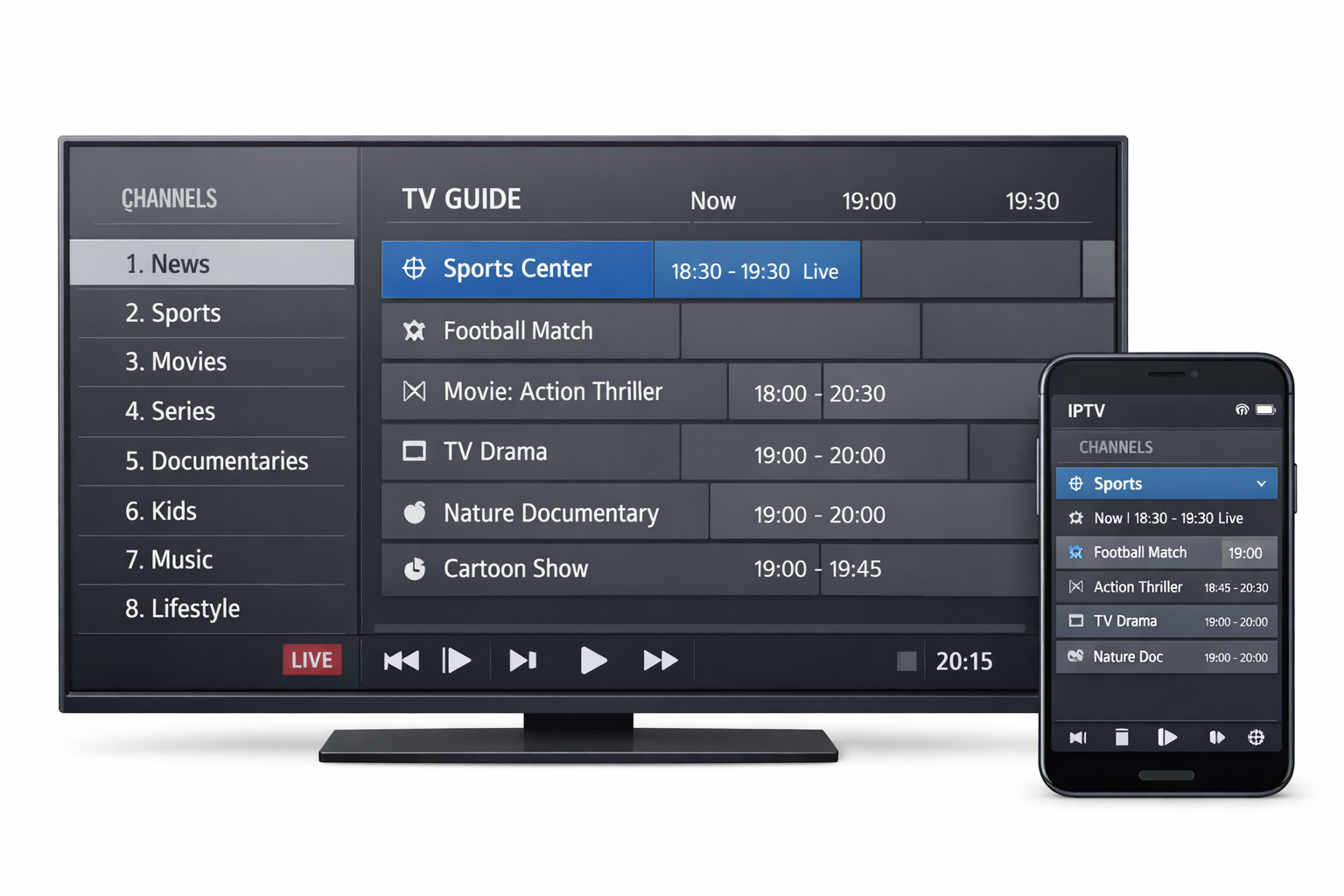
Hero image pack (copy/paste):
- Image prompt: Photorealistic UK living room. A modern smart TV shows a generic IPTV player dashboard (no logos) with neutral tiles: Live TV, Movies, Series, EPG, Favourites, Search, Settings. A streaming box and one remote on the console. No channel names, no copyrighted content, no brand marks. Soft daylight, realistic reflections, professional product-photo look, 16:9, high detail.
- SEO filename: iptv-player-uk-guide.webp
- Exact alt text: iptv player app interface displaying live tv channels and program guide (UK)
Only access content you’re authorised to view, and review terms/policies before using any service.
Jump to what you need
📌 What is an IPTV player?
An IPTV player is a software application designed to play TV and video streams delivered over the internet.
It works like a “front-end” dashboard: it loads content lists from your IPTV access details, then presents them as categories, channels,
on-demand libraries, and sometimes a programme guide (EPG).
What it doesn’t do: an IPTV player typically does not host channels, does not grant rights, and does not
magically improve a weak stream source. It’s a playback and organisation tool.
The player is the app; the service (if you use one) is where your access details come from.
🔄 How an IPTV player works (simple model)
Most IPTV players follow the same basic process:
- Add input: playlist URL/file (often M3U) or portal login (URL + username/password).
- Load library: import channels, VOD items, categories, icons/posters, and EPG (if provided).
- Browse UI: favourites, search, categories, and guide help you find what you want quickly.
- Play stream: your network delivers the stream and your device decodes it in real time.
Why this matters: “Channels won’t load” is usually an input/portal problem.
“Playback buffers” is usually network/device/upstream load. Treat them as separate issues.
🔑 Playlist types: M3U vs portal login (what’s the difference?)
M3U playlist
A playlist URL/file that contains stream entries. It’s widely supported and flexible, but huge playlists can feel heavy on older devices.
- Easy to import
- Works with many apps
- May require a separate EPG URL for guide data
Portal-style login (API / Xtream-style)
A login method that often loads categories and libraries more cleanly (when supported).
It can feel more organised for daily viewing.
- Typically cleaner library structure
- Often easier for favourites and categories
- Still depends on the stream source quality
If you’re testing and switching sources often, M3U can be more flexible.
⭐ Features that matter in real use
Many players advertise long feature lists. In practice, these are the features that make the biggest difference for households:
EPG (programme guide)
Helps you browse by time/show instead of guessing channel names. Requires correct device time/timezone and guide data.
Favourites-first workflow
Build a “Daily 20” favourites list. It reduces menu overload and makes the player feel fast.
Category management
Hiding unused categories can remove lag on low-memory devices and keeps navigation clean.
Search + quick filter
Essential if your library is large. Search saves time more than almost any other feature.
Subtitles / audio track controls
Useful for international content and accessibility, especially on shared devices.
Backup/restore
If you customise favourites and categories, backups protect your setup when reinstalling or switching devices.
📱 Devices that support IPTV players + UK performance tips
IPTV players exist across many platforms, but the best results usually come from a dedicated TV device (stick/box) with stable networking.
- Smart TVs: convenient, but app availability and performance varies
- Streaming sticks/boxes: often best for smooth living-room use
- Android/iOS phones/tablets: great for testing and portability
- Desktop/laptops: useful for troubleshooting and quick input validation
Do one Ethernet test to confirm baseline stability, then improve Wi-Fi positioning if you need wireless.
✅ How to choose an IPTV player safely
Choosing an IPTV player is mostly about matching your device and habits. Use this checklist to avoid “app hopping”.
- Confirm input support: does it support the login/playlist method you actually have?
- Check device fit: will it run on your main TV device smoothly?
- Look for daily features: favourites, EPG, category management, search.
- Assess library size: huge libraries need stronger hardware and better organisation tools.
- Prioritise stability over gimmicks: a simple fast UI beats a feature-heavy laggy UI.
- Plan a “peak-time test”: test during real viewing hours (evenings/weekends) to see realistic performance.
If your goal is a stable family setup, you want fewer steps: favourites-first, clean categories, and a reliable network baseline.
🧩 Buffering: quick diagnosis flow
Buffering is usually caused by one of three things: (1) local Wi-Fi/ISP issues, (2) device decoding limits, or (3) upstream load.
Use a simple “isolation” approach instead of guessing.
Looks like network/device
- Improves closer to the router
- Ethernet is smooth while Wi-Fi buffers
- Only one device buffers
- Problems worsen during downloads/updates
Looks like upstream load
- Works daytime, struggles evenings/weekends
- Live events trigger instability
- Many channels degrade together
- Switching streams helps briefly
Fast test: try the same channel on a second device and once on a hotspot.
If hotspot fixes it, the issue is likely local network/ISP routing. If hotspot doesn’t fix it, the issue is more likely upstream.
📅 EPG not working? Fixes that usually work
- Refresh EPG inside the app and wait 60–120 seconds.
- Check device timezone/time (wrong time = wrong guide mapping).
- Clear cache (avoid “clear data” unless you want to re-login).
- Test another category to see if it’s only one group affected.
- If EPG is empty everywhere, the guide feed may be down or not provided.
❓ FAQ
Does an IPTV player include channels?
No. An IPTV player is a playback tool. You need playlists or access details from a service you already use.
Is a “Pro” IPTV player always better?
Not always. “Pro” usually adds organisation tools and removes ads, but playback stability still depends on your device,
network conditions, and upstream load.
What’s the most important feature for daily use?
Favourites-first + category cleanup. It reduces clutter and makes the app feel much faster.
What’s the quickest way to troubleshoot?
Test the same stream on another device + hotspot once. It isolates device vs network vs upstream issues quickly.
🌐 External resources
Neutral, non-provider references (safe outbound linking).
Related internal posts
- IPTV Pro Explained
- IPTV Stream Explained
- IPTV Subscription Guide
- IPTV Smarters Player Guide
- IPTV Providers Checklist
Internal links strengthen topical authority while keeping outbound links neutral and low-risk.