
A UK-first, practical walkthrough for choosing a plan: what you receive after purchase, what “multi-device” really means, how to test stability, and how to reduce risk before committing long-term.
IPTV Subscription Guide: What to Expect Before You Choose a Plan
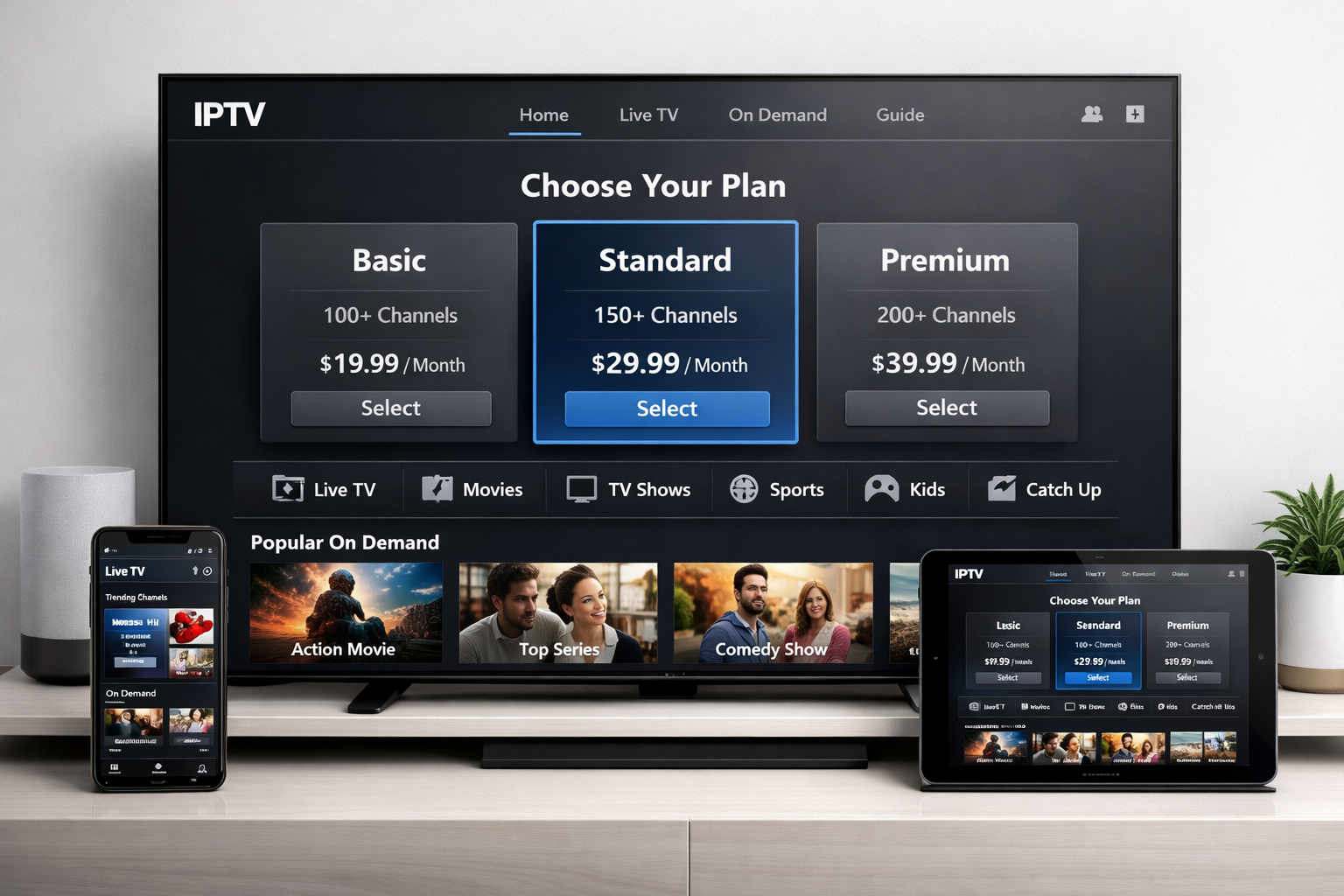
- Image prompt: Photorealistic UK living room scene. A modern smart TV shows a generic IPTV dashboard with neutral tiles (Live TV, EPG, VOD, Catch-up, Settings, Network Test) and a simple “Plan Options” panel (1 device, 2 devices, family). A streaming box and remote on the TV unit, plus a smartphone showing the same generic dashboard. No logos, no channel names, no copyrighted content, no brand marks. Soft daylight, realistic reflections, professional product-photo look, 16:9, high detail.
- SEO filename: iptv-subscription-guide-uk.webp
- Exact alt text: iptv subscription plans displayed on smart tv and mobile streaming app (UK guide)
Jump to what matters most
- What an IPTV subscription actually is
- What you receive after purchase
- Features explained (EPG, VOD, catch-up)
- UK device compatibility (TVs, boxes, mobiles)
- Performance expectations and buffering reality
- A pre-buy checklist (use this before paying)
- Choosing duration and “multi-device” plans
- Legality and safety signals (plain-English)
- FAQs
- Neutral external resources
📌 What is an IPTV subscription?
An IPTV subscription is a paid plan that provides ongoing access to TV-style streaming delivered over the internet. Instead of receiving television through a satellite dish or a cable line, the content is delivered as online streams that play inside an app, an IPTV player, or a set-top device connected to your TV.
In the UK, many people explore IPTV plans because they want flexibility: watching on more than one device, using a smart TV app, or replacing traditional packages with something that fits modern viewing habits. But “IPTV” is a broad term, so the quality and legality of what’s offered can vary massively. This is why choosing a plan is not just about price.
The goal of this guide is simple: help you understand what you’re paying for, what you should expect to receive, how to test stability, and what warning signs to notice before you commit to a long plan.
📦 What you usually receive after you purchase
Many users expect a single “app download” after checkout. In reality, most IPTV setups involve two parts: the service access (your plan) and the player (the app you use to watch). Some providers offer their own app. Others provide details you load into a third-party IPTV player.
Common access methods
- Login credentials: A username/password used inside a compatible app.
- Playlist URL: A link you paste into an IPTV player (often M3U format).
- API-style login: A portal URL + username/password used by many IPTV players for organisation features.
What a “complete” delivery looks like
- Your access details arrive quickly (email or account dashboard) and are clearly labelled.
- There are basic instructions for popular device types (TV box, smart TV, mobile, desktop).
- There is an explanation of device limits (what “1 device” means in practice).
- Support contact methods are visible (and not hidden behind vague promises).
⭐ Features explained: what matters vs what’s marketing
You’ll see a lot of feature lists. Some are genuinely useful. Others are vague labels that don’t guarantee anything. Here’s how to interpret the most common terms without overthinking it.
Live TV
Live TV is the “channel-style” experience where content plays continuously. Reliability here is mostly about stream uptime, server capacity at peak hours, and how quickly the player recovers after a hiccup.
VOD (video on demand)
VOD is a library you pick from, more like a catalogue. It can be well-organised, or it can be messy. For the user, the key is whether it loads quickly, plays without constant buffering, and has consistent metadata (titles, images, categories).
EPG (electronic programme guide)
EPG is the schedule. If it’s accurate, it makes the service feel “TV-like”. If it’s broken or misaligned, it’s frustrating—especially for households that rely on “what’s on now”. A basic EPG is often enough; perfect EPG is rare.
Catch-up / Replay
Catch-up lets you watch something after it aired. This feature is useful, but it’s also one of the first areas to degrade if the backend isn’t well maintained. If catch-up matters to you, you should test it specifically, not assume it “comes included”.
Multi-device / Multi-connection
This is one of the most misunderstood terms. “Multi-device” may mean: you can install the player on many devices, but only stream on one at a time. “Multi-connection” typically means multiple simultaneous streams. The difference matters for families.
📺 UK device compatibility: what to check before you buy
Device compatibility can make or break your experience. A plan might be perfectly fine, but your TV’s app environment might be limited, or your box might struggle with certain stream formats. The safest approach is to map your household devices first.
Common UK setups
- Fire TV devices: Typically strong performance for streaming apps and IPTV players.
- Android TV / Google TV boxes: Often flexible, but quality varies by hardware.
- Smart TVs (LG, Samsung): Great screens, but app availability can be restrictive.
- Phones and tablets: Useful for testing and casual watching, but not a perfect TV replacement.
- Windows / Mac: Good for troubleshooting, quick checks, and stable wired connections.
What “compatible” should mean
- The player you intend to use is available on your platform (or an equivalent alternative is).
- Your device can handle stable decoding (especially if you notice overheating or stutter on older hardware).
- Your remote control experience is comfortable (TV-only apps can be clunky compared to set-top boxes).
- You can use Ethernet (or strong Wi-Fi) near the TV if you care about peak-hour stability.
If you’re unsure, test on the device you will actually watch on most. Testing on a phone only tells you the source works, not that your TV setup will feel smooth.
⚡ Performance expectations: buffering, peak-time, and what’s “normal”
Most complaints in this space come down to one word: buffering. The tricky part is that buffering can be caused by: your local network, your device, your player settings, or the stream source itself. The best approach is to remove variables one by one.
Start with the three biggest stability wins
- Use Ethernet where possible: It eliminates Wi-Fi interference and helps with consistent throughput.
- Reduce network congestion: Heavy downloads, cloud backups, and gaming can impact streaming at peak time.
- Use a capable device: Underpowered boxes can stutter even when the internet is fine.
Peak-time reality
In the UK, many households stream most during evenings and weekends. If you’re evaluating a plan, test at the time you actually watch. A “morning test” can look perfect and still fail later.
Player settings that help (without getting technical)
- Hardware decoding: Keep it enabled on modern devices unless it causes crashes.
- Buffer size: Moderate buffering can smooth jitter; massive buffers can create long delays.
- Playback engine: If your player offers multiple playback options, test both for stability.
- EPG refresh: Set to daily or manual so the app isn’t constantly reloading data.
✅ The pre-buy checklist (use this before paying)
This checklist is designed for real people, not forums. It focuses on signals you can observe quickly: clarity, support, compatibility, and how risky the setup feels. You don’t need to become an expert—just be consistent.
Step 1: Confirm your household needs
- How many screens will stream at the same time (not just installed devices)?
- Which device will be your main TV device (box, smart TV app, stick)?
- Do you care about EPG accuracy, catch-up, or mainly “press play and it works”?
- Do you watch mostly at peak time (evenings/weekends) or off-peak?
Step 2: Check plan clarity
- Is the device/connection limit clearly stated in plain language?
- Are plan durations clear (monthly vs yearly) and is renewal explained?
- Is there a realistic support method (ticket, email, live chat) with response expectations?
- Are you given setup instructions for your device type?
Step 3: Test before committing long-term (when possible)
- Test on your actual TV device, not only on a phone.
- Test during your normal viewing time.
- Test at least three different content types: live playback, VOD (if included), and EPG (if included).
- Watch for simple things: quick start, stable audio/video sync, and consistent navigation.
Step 4: Safety and risk checks
- Avoid sources that pressure you into installing unknown software or “special players”.
- Avoid shortened URLs for portals and playlists if you can’t see the real domain.
- Don’t reuse important passwords across streaming-related services.
- Prefer clear terms, clear support, and clear delivery instructions.
🗓️ Choosing plan duration and multi-device options
Plan duration is mainly a risk decision. Longer terms can look cheaper, but they only pay off if the service stays stable, remains compatible with your devices, and continues to support the features you care about.
Monthly vs quarterly vs yearly (how to decide)
| Plan type | Best for | Main trade-off |
|---|---|---|
| Monthly | First-time testing and low commitment | Higher cost per month |
| Quarterly | Proving stability across multiple weeks | Still some commitment |
| Yearly | Only after proven stability + good support | Highest risk if quality drops |
Understanding “multi-device” properly
Before paying extra for a family plan, define what you need:
- One household, one stream at a time: A single-stream plan is usually enough.
- Two TVs at the same time: You need two simultaneous streams (two connections).
- TV + mobile simultaneously: Still counts as two simultaneous streams.
- Occasional overlap: Some households can manage with one stream if they don’t watch concurrently.
The most common mistake is paying for “multi-device” and discovering it means “install anywhere, watch on one screen”. Ask (or check documentation) for the simultaneous streaming limit.
⚖️ Legality and safety signals (plain-English UK context)
IPTV as a technology is legitimate. The key question is whether the streams themselves are authorised. In the UK, content licensing matters. If you cannot verify authorisation, there is risk. This guide doesn’t offer legal advice, but it can help you recognise practical signals.
Lower-risk signals
- Clear terms and transparent policies.
- Support contact that responds with real troubleshooting steps.
- Clear explanation of what the plan includes (features, devices, limits).
- No pressure to install unknown software outside trusted app stores.
Higher-risk signals
- Vague promises with no clarity on access method or limits.
- Encouragement to use suspicious download sites or “mandatory” installers.
- Constantly changing portals/links with no explanation.
- Pressure tactics pushing long plans without a proper test period.
🧠 What most UK users should realistically expect
A good IPTV experience feels boring—in the best way. You open the app, you choose something, it plays. The more you rely on huge feature lists and unrealistic claims, the more likely you end up with a setup that constantly needs “fixing”.
Reasonable expectations
- Stable playback when your home network is stable.
- Some downtime or changes over time (no service is perfect).
- EPG that is “good enough” rather than flawless.
- VOD that varies by device performance and catalogue organisation.
Unreasonable expectations
- Zero buffering forever, on every device, at every time of day.
- Every feature working perfectly without any setup or testing.
- “Unlimited everything” with no trade-offs.
If you approach your decision with a clear checklist and a realistic test plan, you’ll avoid most of the frustration.
🔗 Related guides on iptv-uk.shop
If you want to go deeper on safety and setup stability, these pages usually help more than endlessly changing apps:
- Is IPTV safe and legal in the UK?
- What is IPTV and how it works (UK)
- Streaming setup basics for UK viewers
If your slugs differ, swap these for your real internal URLs and keep the anchor text descriptive.
❓ FAQs
What should I check first when choosing a plan?
Start with the basics: your main device (TV box/stick/smart TV app), your network stability (Ethernet if possible), and how many screens will stream at the same time. Then confirm the plan’s simultaneous stream limit and what access method you’ll receive.
Is “multi-device” the same as “multi-connection”?
Not always. Multi-device can mean you can install on many devices but only stream on one at a time. Multi-connection usually means multiple simultaneous streams. If you have a household with two TVs running together, you need simultaneous streams.
Why does a plan look fine on my phone but buffer on my TV?
Phones often have strong Wi-Fi and modern decoding, and they’re used close to the router. TVs can be farther away, on weaker Wi-Fi, or running limited app environments. Testing on the actual TV device at peak time is the most honest evaluation.
Do I need an EPG to enjoy IPTV?
You can enjoy basic playback without an EPG, but the guide improves navigation and “TV-like” browsing. If a guide matters to you, test it specifically; don’t assume it will be accurate.
What’s the safest way to test without committing long-term?
Prefer a short plan period where available, test on your main device, and test during your normal viewing hours. Focus on stability, audio/video sync, and how quickly you can get help if something breaks.
Is IPTV legal in the UK?
IPTV as a technology is legal. Whether specific streams are lawful depends on licensing and rights. Use services and content you are authorised to access, and avoid sources that look unsafe or unclear.
🧠 Final thoughts
A strong streaming setup comes from matching a plan to your household reality: your devices, your network, your viewing schedule, and how many screens you run at once. If you treat the choice like a simple checklist—clarity, compatibility, stability testing, and support—you’ll make better decisions and avoid the most common headaches.
Use this IPTV subscription guide as your reference before you pay: confirm simultaneous streams, test during peak time, and prioritise stable delivery over exaggerated feature lists.
🌐 Neutral external resources
General resources about IPTV as a technology, streaming basics, and online safety. (No DMCA-adjacent provider links.)
- IPTV overview (Wikipedia)
- Streaming media basics (Wikipedia)
- What is streaming? (Cloudflare Learning)
- Staying secure online (UK NCSC)
- Copyright basics (WIPO)